Medical Humanities Association conferences are always hugely enjoyable, chiefly because of the diversity of delegates. It's a melting pot of doctors, artists, authors, academics and students, all feeding on each other's creativity and intellectualism. There's nothing like a bit of controversy to spice up a conference, a this year, a good-natured spat surfaced which revealed a very deep-running schism in academia. Squaring up for the rationalists was John Wiltshire of La Trobe University, author of the hugely impressive tome Jane Austen and the Body. In the social constructionist corner was Sander Gilman of Emory University. Both were keynote speakers.
In his talk Wiltshire argued that the 'true' history of medicine has not yet been written: what we have is a history of profession and institutions. History is made up of narratives, but the performative act of medicine robs the patient of the opportunity to shape his/her own story into narrative (for Wiltshire, narratives are primarily written, addressed to a reader and involve an intellectual presence that mere story does not). The 'true history' of medicine is the formal patient narrative which also serves as a valuable critique of medicine, for example Fanny Burney's description of her mastectomy. In the interesting discussion that followed, Gilman said narratives don't necessarily reflect patient reality, they are are patients' encounters with 'the system' and are no more 'true' than other types of narrative. Patrica Law weighed in with the observation that there is a wealth of patient narrative available on the internet (notably DIPEx) which suggests that the patient's unmediated 'voice' is more readily accessible.
The following morning it was Sander Gilman's turn to deliver his address, entitled: 'What is the colour of the gonnorrhea ribbon? Stigma, sexual diseases and popular culture in George Bush's world.' Gilman made a fairly complex argument about shame and political activism. He used as his text a novel aimed at young adults called 'The Rainbow Party' which met with a barrage of criticism because it dealt with oral sex (read the conflicting reviews on Amazon.com to get a flavour of the controversy) in the context of a politically charged debate about what exactly constitutes 'sexual relations' and the abstinence culture. Gilman linked the success of AIDS and cancer ribbons with the successful dissociation of the infected with the means of infection (so one identifies with the sufferer rather than the manner in which the patient became ill). Gilman showed how surveys of sexual activity share with novels the ability to offer an insight into attitudes and fantasies. He argued that STDs would never have a 'ribbon' because of the shame culture. This time John Wiltshire weighed in with a comment about the dubiousness of using 'trashy' novels to talk about social trends, whereas surely proper literature was what could and would effect change (I paraphrase). This caused both tutting and nodding in the auditorium.
At the root of the disagreement between these two distinguished authors, I think, is the notion that for Wiltshire, it is important to give certain narratives priority over others. For Gilman, this ranking of narrative is untenable. Personally, I'm in favour of all narratives contributing to an understanding of attitudes. I don't think 'proper literature' should claim priority in critical analysis, although I accept that in practice it probably does.
There were a lot of thought-provoking sessions at the conference. The full programme can be downloaded here. Borneo Breezes asked how AJ and my session on medical blogging went. We had a lot of interest in our talk, although I hope we didn't put people off by cataloguing the ethical pitfalls in blogging medicine. We couldn't cover much in the 14 minutes allowed but hopefully we gave people a taste for all the good stuff out there.
Monday, September 18, 2006


Thursday, September 14, 2006
Events at the Dana Centre
The Dana Centre on Queens Gate behind the Science Museum has a wonderful programme of events, many of which deal with medical issues. Events are free, but they like you to book in advance. Phone 020 7942 4040 or email tickets@danacentre.org.uk.
Coming up in the next few weeks:
Lifting the Lid on Radiation Risks, 19 September, 19.00 to 20.30
Art of the Brain, 21 September, 18.30 to 21.30
Criminal Minds?, 27 September, 19.00 to 20.30
Senster, 28 September, 19.00 to 20.30 (billed as 'a spine-tingling perfomance that mingles music, art and artificial life')
'You know it makes sense!', 4 October, 19.00 to 21.00 (Red Rinding Hood is put on the psychiatrist's couch)
Personal Identity, 16 November, 19.00 to 20.30 (Baronness Greenfield explains what's human about identity)
I attended last year's 'Art of the Brain' workshop and can really recommend it. It brought together a biochemist-turned-artist (Lizzie Burns) and various neurologists and brain specialists, including pop-scientist Mark Lythgoe. The audience was eclectic but had in common a sense of apprehensiveness at getting to grips with paintbrush in the services of science. An excellent introductory talk by Lythgoe argued that we must be uninhibited if we are to be creative. He used various examples of how some people had bec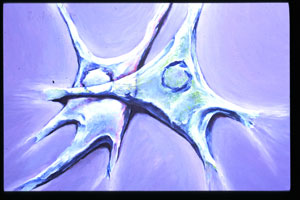 ome very artistic as a result of damage to the fronto-temperal lobe. The disinhibited mind doesn’t screen out so-called irrelevant detail but lets through unfiltered stimuli.
So with the message that we had to let our minds be disinhibited (but fortunately without being literally bashed over the head), we were dispatched to various creative workshops. There was a wealth of materials on offer. Downstairs we created neural paintings. Inspired by images of Lizzie’s work (pictured) and colourful micrographs of neurons, we got busy with paints, pastels, crayons and glitter glue to create a picture inspired by the senses. Upstairs, there were workshops which involved articulating ‘hopes and fears’, and making a memory map (drawing a silhouette of your profile and drawing or writing memories in it). There were also drop-in workshops involving palpating gorgeous polymer clay.
Lizzie had never worked with adults before and was somewhat anxious about how the workshop would go, but as far as I could see it was stunningly successful. At the end, Lizzie wanted to know whether we’d learnt something about the brain. I’m not sure whether this should have been the overriding objective. Indeed, some people may have come away with the impression that neurons are found only in the brain – this would have been my impression had I not studied zoology in the dim and distant past. However, I did learn more about myself, and this surely constitutes learning about the brain.
Coming up in the next few weeks:
Lifting the Lid on Radiation Risks, 19 September, 19.00 to 20.30
Art of the Brain, 21 September, 18.30 to 21.30
Criminal Minds?, 27 September, 19.00 to 20.30
Senster, 28 September, 19.00 to 20.30 (billed as 'a spine-tingling perfomance that mingles music, art and artificial life')
'You know it makes sense!', 4 October, 19.00 to 21.00 (Red Rinding Hood is put on the psychiatrist's couch)
Personal Identity, 16 November, 19.00 to 20.30 (Baronness Greenfield explains what's human about identity)
I attended last year's 'Art of the Brain' workshop and can really recommend it. It brought together a biochemist-turned-artist (Lizzie Burns) and various neurologists and brain specialists, including pop-scientist Mark Lythgoe. The audience was eclectic but had in common a sense of apprehensiveness at getting to grips with paintbrush in the services of science. An excellent introductory talk by Lythgoe argued that we must be uninhibited if we are to be creative. He used various examples of how some people had bec
 ome very artistic as a result of damage to the fronto-temperal lobe. The disinhibited mind doesn’t screen out so-called irrelevant detail but lets through unfiltered stimuli.
So with the message that we had to let our minds be disinhibited (but fortunately without being literally bashed over the head), we were dispatched to various creative workshops. There was a wealth of materials on offer. Downstairs we created neural paintings. Inspired by images of Lizzie’s work (pictured) and colourful micrographs of neurons, we got busy with paints, pastels, crayons and glitter glue to create a picture inspired by the senses. Upstairs, there were workshops which involved articulating ‘hopes and fears’, and making a memory map (drawing a silhouette of your profile and drawing or writing memories in it). There were also drop-in workshops involving palpating gorgeous polymer clay.
Lizzie had never worked with adults before and was somewhat anxious about how the workshop would go, but as far as I could see it was stunningly successful. At the end, Lizzie wanted to know whether we’d learnt something about the brain. I’m not sure whether this should have been the overriding objective. Indeed, some people may have come away with the impression that neurons are found only in the brain – this would have been my impression had I not studied zoology in the dim and distant past. However, I did learn more about myself, and this surely constitutes learning about the brain.
No Obvious Trauma - Review

No Obvious Trauma is a play set in a mental institution in 1933. Two doctors, Dr Weaver and Dr Crawley go about their work, discussing patients and researching papers for their upcoming conference. They are young and optimistic, with hopeful aspirations for their asylum.
One day, a new patient, Ruth, arrives. She flummoxes Dr Crawley with her lack of speech, and he endeavours to investigate her condition.
However, when Dr Weaver sees her for the first time, it sends him on a spiral of memory, missed opportunity and lost love, for she is the very image of Charlotte, with whom he was romantically entangled whilst in Zurich in the past.
The play is a visual delight, combining dance, puppetry and simple sets with tea-dance music and clever use of the sparse stage - drawers become suitcases, wheels of a train, screens are doors, receive projections and provide sillhouettes.
The small cast provides the atmosphere of the echoing-corridor asylum nicely, with strong, slick performances from each actor. Ruth in particular gave a convincing performance of cortorted anguish and rigid fear. Her 'melting' during the course of the play is synonymous with her healing and improvement.
Ruth's condition is based on hysteria and within the play we see the susceptibilities of different personalities to emotional ties and classical themes, such as the over involvement of doctor and patient. I was struck by the dedication of the doctor to his patient, whether alluding to flaws in our modern system or merely praising the old traditional practices.
No Obvious Trauma is an ambiguous tale, with much left open to the imagination. The plot approaches cliche without crossing that line, and in that respect I felt the first act to be more thrilling and satisfying - the manner of explanation in the second act is a difficult plot sequence to convey.
The puppetry reminded me of the 1999 film Being John Malkovich. The use of light and shadow gave the performance a sinister edge, perhaps alluding to the power a doctor wields over his patient, especially given the context of a mental institution. Overall, this was a very enjoyable show, and I would thoroughly recommend it.
Saturday, September 09, 2006
Skypecasts
 Skype, a popular service that provides free voice calls over the internet, has been begun offering a new product allowing users all over the world to participate in real-time discussions with others about... well anything! The preview service, still in beta form, allows you to search for and join a conversation with people also interested in that particular topic. You can then voice your views after being handed the "microphone", all from the comfort of your own home.
This is a new move for the rapidly growing telephony giant, which is famous for its disruptive technology that brings its users closer together through free Skype-to-Skype voice and video calls, and extremely cheap calls to landlines and mobiles across the planet. The new addition to the Skype phenomenon is called Skypecasts, allowing people who download their free software to broadcast their opinions to listeners, like a radio show where you choose the topic you want to discuss.

Recently a number of Skypecasts about medical literature have been quite popular, including one about Geeta Anand's new novel "The Cure" about "How a Father Raised $100 Million--And Bucked the Medical Establishment--In a Quest to Save His Children". This was a popular Skypecast with listeners and contributors from the USA, India and other corners of the globe.
This new form of conversing with others has taken off: authors such as Anand using it to raise publicity for their work, and bloggers have started using it as a more direct form of expression and contact with their readers. Others have used Skypecasts to share their views about access to health care.
Perhaps this is a tool that could be used in the future by support groups, medical associations and even conference organisers. After all, it's free!
Wednesday, September 06, 2006
Travelling Apothecary

As part of the London Design festival, the Wellcome Trust has commissioned a one-day event - Travelling Apothecary - to be held in the Piazza of the British Library between 1000 and 1800 on Saturday 16th September. Stalls at this free event will offer cures for everything from 'network addiction' and 'litter guilt', to 'fantasy flings' and 'home makeovers'. You can find out more here.
Personally I'm quite drawn to Dr Bettler's Network Addiction Herbal Drink, sure to cure all blogging ills! Apparently Dr Bettler (aka graphic designer Alexandre Bettler) is currently working on a project about bread as a means of communication.
Monday, September 04, 2006
Ways of Dying
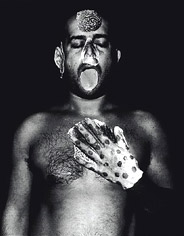 This is Marc Quinn's work Template For My Future Plastic Surgery (1992). It is used by the Tate to represent a half-day symposium, Ways of Dying, which will be held at Tate Modern on Saturday 14th October from 1400-1930. It will explore the relationship between life and death in contemporary cultures, drawing on the fields of art, philosophy, law, medicine, political theory, gender and cultural studies, biotechnology and environmental sciences. The program shows a top class field of speakers and papers. Oh, and there are drinks and music afterwards. You can find out more and book tickets here.
Sunday, September 03, 2006
Baghdad ER
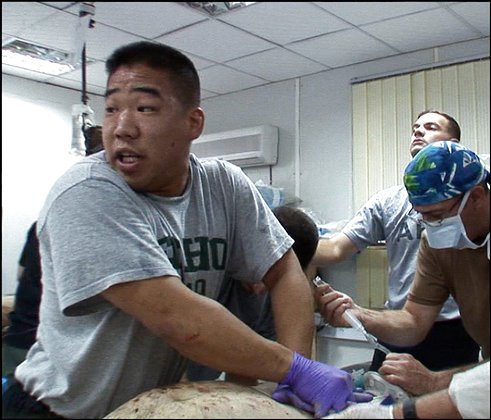 Showing on More4 on Wednesday night is Baghdad ER, an Emmy-winning documentary about the 86th Combat Support Hospital, a US army facility in Iraq. The 60-minute film is controversial. US army representatives refused to attend a screening because they thought it would engender negative feelings about the war. (As if any coverage of Iraq might engender a positive attitude.) The Army Surgeon General also issued a warning that if ex-combatants watched the film, they could suffer from post-traumatic stress. I have a feeling that watching this documentary might make all the 'gritty' medical and/or war dramas seem a pale shadow of reality.
I am in two-thirds through reading the Regeneration trilogy by Pat Barker. It is a tightly written and well-researched series of novels that focuses on the psychological treatment of soldiers in World War I. Barker uses the lives of the famous war poets, Siegfried Sassoon and Wilfred Owen, and their relationship with psychiatrist William Rivers as the basis for her books. She brilliantly merges biography and imaginative writing to explore issues of conscience and psychosis. I particularly like the snatches of poetry intermingled in the narrative. My mother was unavoidably my English teacher at our school for a while, and I recall with pleasure her teaching us the war poets. Rediscovering them in Barker's novels is like coming across old friends and finding them changed but the same somehow.
Yet another take on the war poets is to be found in Paul Fussell's fascinating book The Great War and Modern Memory. First published in 1975, the book documents in exquisite detail the irony of how the awfulness of war gave rise to beautiful and sensistive literature. It is an amazing exposition on how metaphors, far from being 'merely' figures of speech, engender concrete actions with often tragic results. Particularly insidious was the sporting metaphor which permeated discourse about the First World War. At the Somme, a captain offered a prize to the platoon which first kicked a football up to the German front line in the interests of 'a sporting spirit'. Fussell marries word, symbol and action in attempt to explain how the First World War is still surrounded by unwarranted romanticism. I can't recommend it highly enough.
Subscribe to:
Posts (Atom)