Tuesday, June 21, 2005
The value of poetry in healthcare
Maurice Bernstein has started a discussion on the value of poetry in medicine in his Bioethics Discussion blog, prompted by this article in Community Ethics.


Book review: 'Adam's Navel' by Michael Sims
Robin Som writes:
Considering the definition of anthropology - 'the scientific study of the origin, the behaviour, and the physical, social, and cultural development of humans' - it is strange that it is missing from teaching in most medical schools – human beings are the bread and butter of the medical profession. In Adam’s Navel, Michael Sims uses a variety of disciplines including medicine to explore the cultural and scientific significance of the human body, part by part. Everything, with a few exceptions, from the hair to the hands to the genitalia to the toes – is scrutinised for historical facts, figures and anecdotes.
It is an interesting idea. It would be nice to know the origin of the many beliefs we hold about our bodies – how did the eyes become 'the window to our souls'? Exactly what is it about breasts and bums that make them sexually attractive?
Sadly a promising concept fails in the hands of Sims. Adam’s Navel is part encyclopaedia, social history, journalism and textbook; and these various styles do not gel to form a cohesive read. Scientific terms – that are rarely explained – such as ‘hominid diaspora’ sit uneasily with wisecracks that only sometimes hit the spot. Sims flits from references to notable scientists such as Darwin and Desmond Morris to tales of Hollywood actresses Veronica Lake and Rita Hayworth. Of course, there is nothing wrong with this type of eclecticism – it just needs to be done well!
What could’ve been an enlightening and entertaining read unfortunately becomes a frustrating, long list of trivia. Here’s hoping the powers that be at medical school ignore Adam’s Navel if they ever consider throwing a bit of anthropology in with anatomy, neuroscience et al.
Considering the definition of anthropology - 'the scientific study of the origin, the behaviour, and the physical, social, and cultural development of humans' - it is strange that it is missing from teaching in most medical schools – human beings are the bread and butter of the medical profession. In Adam’s Navel, Michael Sims uses a variety of disciplines including medicine to explore the cultural and scientific significance of the human body, part by part. Everything, with a few exceptions, from the hair to the hands to the genitalia to the toes – is scrutinised for historical facts, figures and anecdotes.
It is an interesting idea. It would be nice to know the origin of the many beliefs we hold about our bodies – how did the eyes become 'the window to our souls'? Exactly what is it about breasts and bums that make them sexually attractive?
Sadly a promising concept fails in the hands of Sims. Adam’s Navel is part encyclopaedia, social history, journalism and textbook; and these various styles do not gel to form a cohesive read. Scientific terms – that are rarely explained – such as ‘hominid diaspora’ sit uneasily with wisecracks that only sometimes hit the spot. Sims flits from references to notable scientists such as Darwin and Desmond Morris to tales of Hollywood actresses Veronica Lake and Rita Hayworth. Of course, there is nothing wrong with this type of eclecticism – it just needs to be done well!
What could’ve been an enlightening and entertaining read unfortunately becomes a frustrating, long list of trivia. Here’s hoping the powers that be at medical school ignore Adam’s Navel if they ever consider throwing a bit of anthropology in with anatomy, neuroscience et al.
Monday, June 20, 2005
'Looking Aloud'
We're delighted to announce the first ever exhibition of art produced by Imperial College's Medical Humanities students. The work will be on view in the Blyth Gallery, 5th Floor, Sherfield Building, Imperial College London, from 29 June to 11 July 2005. The exhibition is open to the public.
The exhibition is a result of an assignment on the Medical Humanities taught option in the BSc year. Students produced a visual object that engaged with a theme covered in the course, e.g. clinical detachment, mortality, the medical gaze, popular perceptions of medicine. Each work is accompanied by a explanatory commentary. The standard was so impressive that we felt it merited an exhibition.
The photograph shown here is part of a piece by Jenny Eades which explores the doctor/patient relationship.
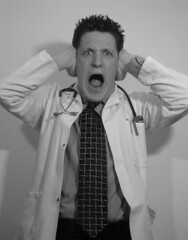
The exhibition is a result of an assignment on the Medical Humanities taught option in the BSc year. Students produced a visual object that engaged with a theme covered in the course, e.g. clinical detachment, mortality, the medical gaze, popular perceptions of medicine. Each work is accompanied by a explanatory commentary. The standard was so impressive that we felt it merited an exhibition.
The photograph shown here is part of a piece by Jenny Eades which explores the doctor/patient relationship.
Thursday, June 09, 2005
'Breathing for a Living': book recommendation
Ivor Lewin writes:
I strongly recommend a book called ‘Breathing for a Living’ by Laura Rothenburg, Hyperion Books. It is memoir written by a cystic fibrosis sufferer who died while at Brown University. It is very well written in a style expected from a teenager/uni student and differs from most of the illness memoirs for a number of notable reasons. IT IS NOT A BOOK ABOUT CANCER! It is not a triumphant “I fought the disease and won” rant nor is it a “Terrible news: I’m going to die” book either. It is unique in that the author has known and been aware of her disease from the moment of consciousness and more importantly knows that she is going to have a short life in which she may die at any moment. Her writing documents her largely successful attempts to live a normal life of a teenager while experiencing repeated long term hospitalisations and latterly the agonising wait for and ultimately successful although futile heart/lung transplant. Most of her friends were also CF sufferers whom she had to cope with outliving. Although the book does have weaknesses (the eulogies at the end are rather American and don’t really do it for me and also her final chronic rejection resulting in her death is not mentioned at all) it is definitely worth a read. Furthermore the educational value of this book in teaching about CF is useful for any medical student in a way that we have cancer rammed down us the whole time!
I strongly recommend a book called ‘Breathing for a Living’ by Laura Rothenburg, Hyperion Books. It is memoir written by a cystic fibrosis sufferer who died while at Brown University. It is very well written in a style expected from a teenager/uni student and differs from most of the illness memoirs for a number of notable reasons. IT IS NOT A BOOK ABOUT CANCER! It is not a triumphant “I fought the disease and won” rant nor is it a “Terrible news: I’m going to die” book either. It is unique in that the author has known and been aware of her disease from the moment of consciousness and more importantly knows that she is going to have a short life in which she may die at any moment. Her writing documents her largely successful attempts to live a normal life of a teenager while experiencing repeated long term hospitalisations and latterly the agonising wait for and ultimately successful although futile heart/lung transplant. Most of her friends were also CF sufferers whom she had to cope with outliving. Although the book does have weaknesses (the eulogies at the end are rather American and don’t really do it for me and also her final chronic rejection resulting in her death is not mentioned at all) it is definitely worth a read. Furthermore the educational value of this book in teaching about CF is useful for any medical student in a way that we have cancer rammed down us the whole time!
Tuesday, June 07, 2005
The blogtor is in
An interesting article has appeared in the LA Times on doctors writing blogs. How did I find out about this? Medlogs.com is a good way of keeping track of cybermedical news.
Monday, June 06, 2005
Ricky Swallow's I-Man
Ricky Swallow's I-Man prototype interested me in the arts section of the Telegraph on Saturday:
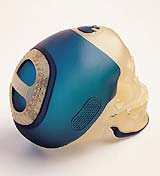
I-Man Prototype
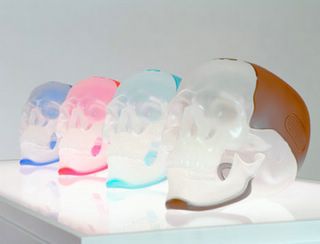
I-Man Skulls
As an IPod owner I appreciate the vague satire; Apple has used a combination of aesthetics and technology to create not only a brand but a fashion label - clever marketing targeting not one but almost five senses (ISmell has a problematic name...). The skull brings together technology and medicine, not for therapy, but for a more sinister purpose. It reminds me of the skull of the terminator from the 1985 film.
The work is reviewed here, with some interesting comments on the significance of the skulls. Another comment by the curator of the original exhibition is here, relating to the idea that the piece represents the futility of attachment to material things.
Ricky Swallow's work from 2001 is featured at the Biennale in Venice this summer. There is further telegraph comment here.

I-Man Prototype
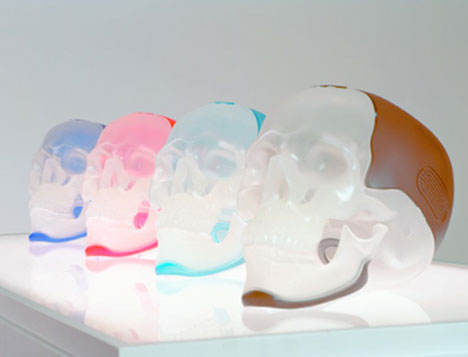
I-Man Skulls
As an IPod owner I appreciate the vague satire; Apple has used a combination of aesthetics and technology to create not only a brand but a fashion label - clever marketing targeting not one but almost five senses (ISmell has a problematic name...). The skull brings together technology and medicine, not for therapy, but for a more sinister purpose. It reminds me of the skull of the terminator from the 1985 film.

The work is reviewed here, with some interesting comments on the significance of the skulls. Another comment by the curator of the original exhibition is here, relating to the idea that the piece represents the futility of attachment to material things.
Ricky Swallow's work from 2001 is featured at the Biennale in Venice this summer. There is further telegraph comment here.
Pass the shades...
The Guardian has give a very enthusiastic reception to architect Will Alsop's bright design of the new Institute of Cell and Molecular Sciences at Queen Mary's. There is an ongoing debate about the value we should put on making people 'feel better' in hospitals, beyond what drugs and medical intervention can do. Design is one aspect of this. Of course, it's not only patients that should feel better -- staff need a boost too. The photos of the building remind me of lollipop-loving garden-designer Diarmuid Gavin let loose on an interior, but no one could argue that it doesn't look cheerful.
Subscribe to:
Posts (Atom)