Wednesday, September 28, 2005

'Now, Voyager'


A thoroughly good time was had at the Purple Coat meeting last night, lubricated by a generous donation of wine. 'Now, Voyager' was both touching and hilarious -- and afforded a real insight into the 1940s and what passed as female empowerment. The story draws on a rich tradition of 'transformation': in this case, neurotic 'ugly duckling', Charlotte, is sent on a cruise by her psychiatrist in an effort to overcome the negative influence of a domineering mother. There she meets and falls in love with a married man. Naturally, things must remain chaste so ritualistic cigarette smoking acts as a substitute for sex ('The film must have been sponsored by Marlborough', said AJ). The plot is satisfyingly twisty and wonderfully melodramatic. We all agreed the acting was splendid, especially Bette Davis as Charlotte and Gladys Cooper as the matriarch. One can see why this film is such a treat for film theorists. Although all the female characters are strong and powerful, the measures of success are still deeply paternalistic: beauty, wealth, social accomplishment and the love of a man. These are my views, informed by the lively post-film discussion. Please do chip in with more commentary...

Tuesday, September 27, 2005

Death of a Salesman


On the weekend I watched Death of a Salesman, which came heavily recommended by a close friend. Starring Dustin Hoffman and John Malkovich, this Arthur Miller play was brought to celluloid in 1985.

Dustin Hoffman plays Willy Loman, and won a Golden Globe for best actor in this performance. Willy is a man on the brink of a breakdown cum late-life-crisis, as his once promising career as a salesman has dwindled to nothing, his sons have amounted to nothing and he experiences increasingly severe manic-depressive episodes.

The film retains the feeling of a play, with simple sets and minimal sophistication, being mostly filmed as mid-shots, with little zooming or long shots. Towards the climax of the film we see more close-ups, which is surprising considering the intensity of the film. I was blown away by the acting in the film as so often in the cinema, you are brought into the world of the film; yet this was the first time whilst watching a film that I felt like I was actually at the theatre. The performances are powerful and empassioned, the cast is small and scenery bare (set mostly in the Loman house, and disorientatingly occasionally in other locations), which all contribute to a raw sense of emotion throughout the film.

I was quite exhausted by the end, although the film was quite an experience. It is not the sort of film that one might watch idly, it requires concentration and thought - plus time (it is 133 minutes long).

Anyone interested in mental health will like the film for its handling of nervous breakdowns, mania, depression and kleptomania. Others will relate to the family dynamics and reflection within the film.

Monday, September 26, 2005

The Motorcycle Diaries


Last week I managed to watch The Motorcycle Diaries, directed by Walter Salles. Based on the journals of Alberto Granado and Ernesto Guevara (a.k.a "Che" Guevara), the film charts the companion's journey from Buenos Aires around South America on a battered 1939 Norton 500 motorcycle.

Alberto is a biochemist and Ernesto a medical student only one semester away from qualifying. Ernesto has various opportunity to practice his skills on their journey, not least when they arrive at a leper colony in the Peruvian Amazon. We see the beginnings of Ernesto's later political inclination when he becomes bothered by the segregation in the leper colony, and refuses to wear gloves to treat the patients, irritating the nuns who run the colony. One night during his birthday celebrations, Ernesto swims across to the leper colony from the 'safe' side of the river where the uninfected live. This symbolic moment encapsulates Ernesto's 'crossing over to the other side' both politically and medically; his approach to patients is both unconventional and passionate.

Having travelled in Peru last year I had wanted to see this film for its footage of Machu Picchu and the Amazon, and was pleasantly surprised to discover Che Guevara was a trained doctor. Although he finished his training, he never completed an internship, and as we all know went onto pursue a political career before being assassinated in 1967. His companion Alberto is still alive today, living in Cuba, having co-founded the Faculty of Medicine at the University of Santiago.

There is a Guardian Interview and info about the film available too. Overall a good film whether you are medically or politically minded or interested in foreign culture.

Sunday, September 25, 2005

Generation Gap

Her house smells comfortingly of shortbread and tea and young cat,
Stories spill flitting between all nine of her decades.


I stare at her head pondering on neurons,
The odd intensity of her delivery,
On and on, fast she talks, exhausting,
And only the inhaler interrupts.


In the digression I visualize her mind map;
Overlapping, intertwining and cloudy blots.
Expelling itself before the time takes over,
A lengthy legacy to be left.

Friday, September 23, 2005

Suction

A writhing snake
Bucks and quivers,
Thrilling bliss.

Red splashes
And orange streaks
Are its markings
Camouflage-
As it slithers into the incision
Stealthily, a clear, hungry belly.

Fluid slurped turbulently
Gushes through its coils
A hard greedy mouth
Becomes blocked by debris
Choking the hiss.

‘Suction please.’

Alex J Hamilton

Thursday, September 22, 2005

Next Purple Coat Club meeting

There will be a screening of 'Now, Voyager' at 7.30 pm. Please note the change of venue: we'll be meeting in the MDL overflow room, level 1, Sir Alexander Fleming Building on the South Kensington Campus at Imperial College London. E-mail me if you need further directions.

Everyone is welcome -- there is no 'membership' as such. I received a very nice letter from Danny Abse giving me permission to reproduce on the blog the poem from which the Purple Coat Club takes its name:

Pythagoras’s song

by Dannie Abse

White coat and purple coat
a sleeve from both he sews.
That white is always stained with blood
that purple by the rose.

And phantom rose and blood most real
compose a hybrid style;
white coat and purple coat
few men can reconcile.

White coat and purple coat
can each be worn in turn
but in the white a man will freeze
and in the purple burn.

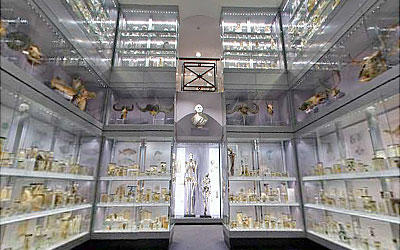
Hunterian Museum, London


I enjoyed a long overdue visit to the Hunterian Museum yesterday. It occupies floor space in the Royal College of Surgery, near Lincoln's Inn Fields in London. The museum was refurbished about a year ago and the results are very aesthetically pleasing. The museum is a showcase for the collections of John Hunter, younger brother of the more-famous William after whom the Hunterian Museum in Glasgow is somewhat confusingly named. John was originally apprenticed to his older brother before becoming an anatomist, a collector, and a surgeon in his own right. His collections, beautifully displayed in spot-lit glass cases, include a huge range of anatomical and pathological preservations as well as natural history specimens from all over the world. Particularly impressive is the skeleton of the 'Irish Giant', Charles Byrne. There is an art exhibition on at the moment showing the work of the Medical Artists Association.

There are free, half-hour tours of the Museum at 1 pm on Wednesdays where you can learn more about John Hunter -- it's a fascinating story.