On Thursday 9th March I went to a Consumer's forum public lecture: Recurrent Miscarriage given by Professor Lesley Regan at the RCOG.
It was a captivating talk which was aimed at a wide audience. Prof Regan successfully managed to cover the basics of recurrent miscarriage - definition, causes, treatements etc as well as convey the psychological and physical trauma these women endure. She included lots of photos to emphasise the reality of the problem and kept it simple so everyone could understand.
Sadly the questions afterwards were mainly of a personal nature rather than general, there were lots of women in the audience who wanted their stories to be heard and Prof Regan stayed behind later to listen to those who were reticent.
It was an enlightening lecture and I highly recommend any future public events at RCOG.
http://www.rcog.org.uk/index.asp?PageID=101&ConferenceID=154
Monday, March 13, 2006


Wednesday, March 08, 2006
This from the Enlightenment ethusiasts, the Institute of Ideas.
TABOOS
By Carl Djerassi
Saturday 18 March
Early matinee from 2.30pm to 4.40pm
Debate from at 5.00pm to 6.30pm
Tickets for Matinee and debate £19/ £17 concessions
Tickets for debate only £9/ £7 concessions
New End Theatre Box office - 0870 033 2733
Terms such as 'marriage', 'family', and 'parent' used to have firm denotations. They were the rock on which many of our cultural values rested. Terms such as 'embryo', 'baby', or 'twin' were also considered unambiguous. But recently, all these terms have become destabilized, their meanings blurred, their range extended. Some would blame in vitro fertilization technology for these developments, but in fact major social and cultural changes, primarily in the USA and Europe, were more responsible for the monumental shift that has caused so much fear and antagonism, especiallyamong the ever increasingly strident fundamentalists in the USA. So why not write a play about a situation where 'family' and 'parent' have assumeddisturbingly fuzzy meanings? TABOOS may be seen as a classic tale of scientific progress. A scientific innovation is greeted with outrage from traditional moralists, who predict the collapse of society if the innovation is allowed. But the secular lawpermits the innovation (because there are deserving cases) and society learns to cope, until the next challenge when the whole process is repeated. TABOOS cleverly raises as many questions as it answers. Are not the fundamentalist Christians on uncertain ground basing themselves on a holy book full of unusual family set-ups and a messiah who is the product of a surrogate birth? Will not the lawyers be the main beneficiaries of the legal complications of alternative families? What does a child in a lesbian family call its two 'mothers'? Above all, is it science that is pushing these issues forward, or is it society insisting scientists come up with solutions to questions that traditional social institutions can no longer answer?
Wednesday, March 01, 2006
Congratulations AJ!
Regular readers look forward to AJ's blog submissions which are invariably well argued and throught-provoking. Today sees the publication in the sBMJ of an important article by AJ on attitudes to male obstetrics and gynae students. This ties in with recent concern by the RCOG on falling numbers of doctors opting for the specialism. You can read the article here.
Monday, February 27, 2006
'Wires' - Athlete
I've always liked the album 'Tourist' by the band Athlete. Listening last night I realised the medical theme of their Top 5 hit 'Wires'...
You got wires going in
You got wires coming out of your skin
You got tears making tracks
I've got tears that are scared of the facts
Running down corridors, through automatic doors
Got to get to you, got to see this through
I see hope is here in a plastic box
I've seen Christmas lights reflect in your eyes
You got wires going in
You got wires coming out of your skin
There's dry blood on your wrist
Your dry blood on my fingertip
Running down corridors, through automatic doors
Got to get to you, got to see this through
First night of your life, curled up on your own
Looking at you now you would never know
I see it in your eyes; I see it in your eyes
You'll be alright
I see it in your eyes; I see it in your eyes
You'll be alright
All right
Running down corridors, through automatic doors
Got to get to you, got to see this through
I see hope is here in a plastic box
I've seen Christmas lights reflect in your eyes
Running down corridors, through automatic doors
Got to get to you, got to see this through
First night of your life, curled up on your own
Looking at you now you would never know

You got wires coming out of your skin
You got tears making tracks
I've got tears that are scared of the facts
Running down corridors, through automatic doors
Got to get to you, got to see this through
I see hope is here in a plastic box
I've seen Christmas lights reflect in your eyes
You got wires going in
You got wires coming out of your skin
There's dry blood on your wrist
Your dry blood on my fingertip
Running down corridors, through automatic doors
Got to get to you, got to see this through
First night of your life, curled up on your own
Looking at you now you would never know
I see it in your eyes; I see it in your eyes
You'll be alright
I see it in your eyes; I see it in your eyes
You'll be alright
All right
Running down corridors, through automatic doors
Got to get to you, got to see this through
I see hope is here in a plastic box
I've seen Christmas lights reflect in your eyes
Running down corridors, through automatic doors
Got to get to you, got to see this through
First night of your life, curled up on your own
Looking at you now you would never know

I saw another significant case today: a thirteen year-old girl who presented acutely with Diabetic Ketoacidosis. This is an acute presentation of diabetes, whereby the body has begun to metabolise fat and protein, as in starvation. Patients complain of thirst and frequent passing of urine, and smell of pear drops, lose much weight and present with collapse or coma.
After suffering symptoms for only a few days, and having initially put the symptoms down to a urinary tract infection, the girl ended up in A&E, where she was transferred to the Paediatric Intensive Care Unit, where she spent two weeks in a coma. When she came round she was agitated, and thus sedated. She has neurological injury from the high pH (caused by the acidic ketone bodies produced) which has damaged her brain.
Dealing with loss is hard enough, but it seems so unfair when it affects a child, especially in such a dramatic way. I found it difficult to detach myself from the emotion surrounding the issue, and think about the practical multi-disciplinary approach that I ought to be considering. I do hope, like in the song, the girl will be alright.
Friday, February 24, 2006
Great Ormond Street Hospital
I visited Great Ormond St Hospital this afternoon as part of the Paediatrics course. The doctors there received us warmly (they don't normally have students) and taught us at the bedside. The experience made me think of a piece by Edvard Munch (famous for 'The Scream') called 'The Sick Child':
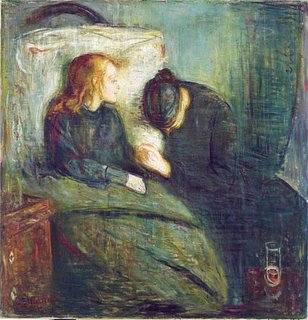
I was surprised that 8 students were taken on bedside teaching in one go, we made for an intimidating bunch for sick children. We visited a dozing child with a vastly distended abdomen. He was alone and one of us examined his tummy. I was saddened to see him awaken (yet remain confused and drowsy) and yelp plaintively during the exercise. The doctor informed us that he was 'a practised patient' and we weren't really hurting him - although his recoil and discomfort made me think otherwise.
We were encouraged to distract him with play - to no effect - but all the while I felt that I was somehow intruding where I shouldn't be. His parents were not there to consent to our presence, and the despondency of his medical condition was heart-wrenching. However, there was a definite air amongst the students - one of quiet respect, compassion, and sadness.
Having spent a reasonably peaceful week on the postnatal wards, I felt I had been exposed to the darker side of Paediatrics. Spending the morning performing baby-checks on newborns was a stark contrast to both the neonatal intensive care unit I later visited, seeing tiny premature babies in respiratory distress, gasping and grunting for breath.
Paediatrics seems an ideal opportunity for students to examine their own ideas about empathy and compassion. I'd be very interested to hear others experiences...
Thursday, February 23, 2006
Radio Ballad tackles AIDS
Radio 2 first aired a series of 'radio ballads' in the 1950s and 60s in which the voices of communities are blended with sounds and songs on the topics. 'The Body Blow', first broadcast in 1962, dealt with polio. The ballads have now been updated and are being broadcast from next week on Radio 2 at 9 pm. The one on AIDS, 'Enemy Within', was deemed excellent by a preview panel on 'Front Row'. It is due for broadcast on 6 March, 9 pm.
Wednesday, February 22, 2006
Jonathan Kaplan on 'Midweek'
 Jonathan Kaplan, author of 'The Dressing Station' and now 'Contact Wounds', was interviewed this morning on Midweek on Radio 4. It will be on again at 9.00 pm tonight or you can listen again through the website for a week. 'Contact Wounds' is garnering good reviews, from what I've seen of the press (see here), although the consensus seems to be -- as AJ implied in his review of 'Dressing Station' -- the man still comes across as 'clinically detached' even though he writes autobiographically. There's an interview with him in 'The Times' here.
Subscribe to:
Posts (Atom)